What are young people hoping to see in tomorrow's Federal Budget?
March 23, 2025
With the federal election on the horizon, young Australians now make up the highest proportion of voters - and they’re keen to make their voices heard. From mental health and education to job security and climate action, the issues that matter most to young people are shaping conversations across the country.
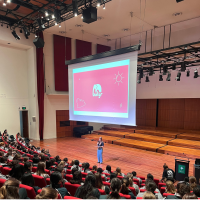
In our pre-budget submission, we called for urgent investment in prevention, early intervention, and lived experience storytelling. While funding mental health services is crucial, we know that preventing challenges before they escalate is just as important.
Our proposal outlined how additional funding across four years could allow us to:
- Deliver 654 peer-to-peer school and university mental health programs
- Provide 32 free Being Herd lived experience workshops so young people can learn how to talk about their journey with mental ill-health in a safe, impactful way
- Integrate our free mental health storytelling app, OurHerd, with 150 community cohorts
Through these initiatives, we would be able to collectively support the mental health of over 227,000 young people across the country, as well as see earlier and more regular help-seeking, more socially cohesive communities and a stronger mental health system.
What are young Aussies hoping to see in tomorrow's budget?
We asked our community of young people, including our network of lived experience storytellers, what they’re hoping to see in tomorrow’s budget announcement. Here’s what some of them had to say:
“Early intervention programs in schools/universities, or maybe even a dedicated class for this. I would also like to see more group programs that are frequent and easily accessible for youths. And also free mental health care is a big priority.”
- Miranda, QLD
“Subsidising more appointments for psychologists so as that there isn't a limit as to how many appointments you can receive as part of your mental health care plan.”
- Issi, NSW
“I’d like to see investment in preventative mental health programs, like the work that batyr does, so that more young people nationwide are equipped and empowered to take charge of their mental health, but also achieve a reduced sense of self-stigma so that should they experience mental ill-health and decide it would be beneficial to seek help, that stigma isn’t a barrier to them doing so.
In the same breath, ensuring that support is available when needed is equally crucial to tackling the youth mental health crisis – and so providing investment that eliminates and/or addresses current systemic barriers such as the mass resignation of psychiatrists in NSW is critical to improving the state of youth mental health in Australia. Reducing the financial barriers entailed such as by committing to providing free mental health care for under 25’s (just as Mental Health Australia is advocating for) is also a powerful, productive and highly beneficial investment that I believe the federal government can make to meaningfully support and tackle the youth mental health crisis.”
- Mel, NSW
“I would love to see more investment in the prevention and public education of complex mental ill-health conditions. I’d also love to see more in preventative services and mental health education that’s actually proven to work. Prevention services need to exist for young people right across the country, not just in the metro areas with higher populations, so I really hope that our country’s leaders step up and recognise that so many young people in regional, rural and low socioeconomic areas are missing out.”
- Crystal, NSW
“I think more money needs to be invested in support services. The services available are under-resourced and under-funded. The quality of care varies greatly from these services."
- Michaela, QLD
“I’d love to see investment in low SES schools, enforce wellbeing support in schools including SSOs and SSLOs and put a large amount of the budget into Autistic youth wellbeing. Additionally, paying young people for their ideas!”
- Emily, NSW
“Immediately, at a minimum, I would love to see the number of Mental Health Care Plan sessions increased from 10 sessions back to 20 sessions, as is recommended by the Australian Psychological Society. However, thinking more broadly, what I really believe is crucial to tackling the youth mental health crisis is investing in initiatives and ‘third spaces’ which build a sense of community and belonging. There also needs to be investment in peer-based, non-clinical models of support which recognise that some people feel safer and better supported when engaging with a person who themselves has a lived experience of mental health challenges. Beyond this, I would also love to see recognition of the how global and national political, social and environmental crises impact youth mental health, and see the government take a holistic strategic approach which addresses the drivers of distress rather than purely the symptoms.”
- Zali, QLD
You can watch the Federal Budget 2025 tomorrow from 7:30pm on ABC News.